



A "Japanese Sake Flavor Map" that visualizes the taste of Japanese sake.
What does this map reveal about the long-loved reasons behind "Karatanba"?
Japanese sake
A "guidepost"
Even sake brewed in the same brewery can have different flavors depending on the type, such as junmai-shu or honjozo-shu. Furthermore, even within the same junmai-shu, subtle differences in brewing and preparation conditions can result in variations in both taste and aroma. There are as many flavors as there are types of sake. This is truly the magic of sake. However, it's also true that having so many different flavors can be overwhelming. Ozeki has developed a "Sake Flavor Map" to serve as a guide to these flavors.
A that everyone can agree on
Aiming for clear indicators
Ozeki Research Institute was involved in the analysis using taste sensors in the development of the "Sake Taste Map." In addition to developing brewing technologies, the institute conducts various research and development activities centered on fermentation technology. The purpose of developing the "Sake Taste Map" was to quantify the diverse flavor characteristics of sake and objectively evaluate the indicators using taste sensors, so that everyone can clearly answer the question, "What kind of sake do you like?"
-
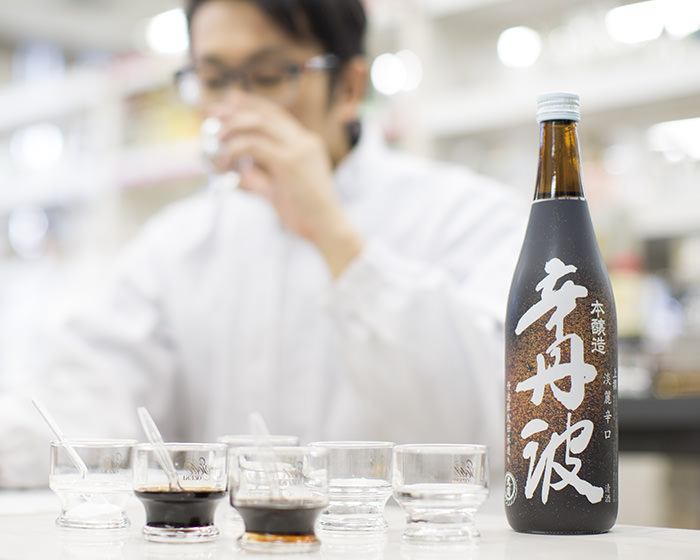
Sensory tests were conducted to determine the compatibility with various seasonings. "Karatanba" is compatible with a wide range of seasonings.
-

The values measured by the taste sensor were processed using a special calculation formula. The goal was to create a map that effectively represented the characteristics of each flavor.
-
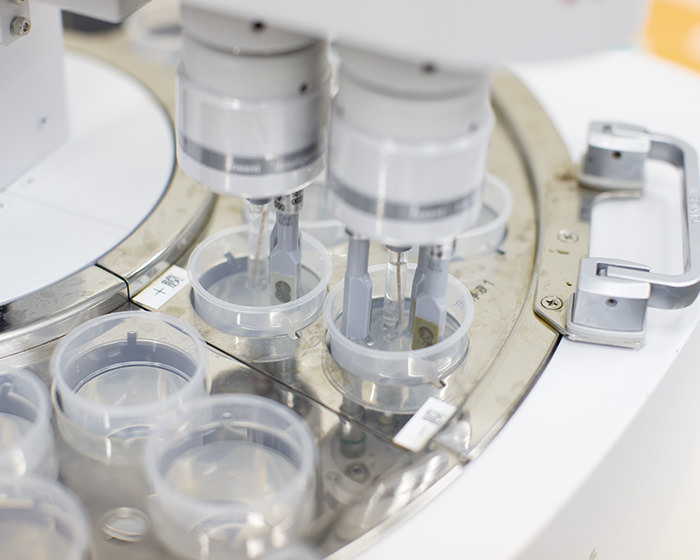
Taste sensor. A sensor that mimics the human tongue is immersed in a sample to measure its properties. The data is sent to a computer as numerical values.
135 types of samples
Statistical analysis and sensory evaluation testing
A "taste sensor" is, quite literally, a sensor that can quantify the five basic tastes—umami, sourness, saltiness, bitterness, and astringency—just like a human tongue. Using this, the research institute measured the taste of 135 commercially available sake samples. The measurement results were then combined with general analytical data such as sake meter value, acidity, amino acid content, and alcohol content, and plotted on a map. The key point of the "Sake Taste Map" is "visualization of taste." More than 5 members sensory evaluated the sake mapped to each area on the map, and by statistically analyzing the resulting taste comments, the most appropriate words were derived to describe the taste characteristics of each area.
From a different perspective
Visualizing the taste of Japanese sake
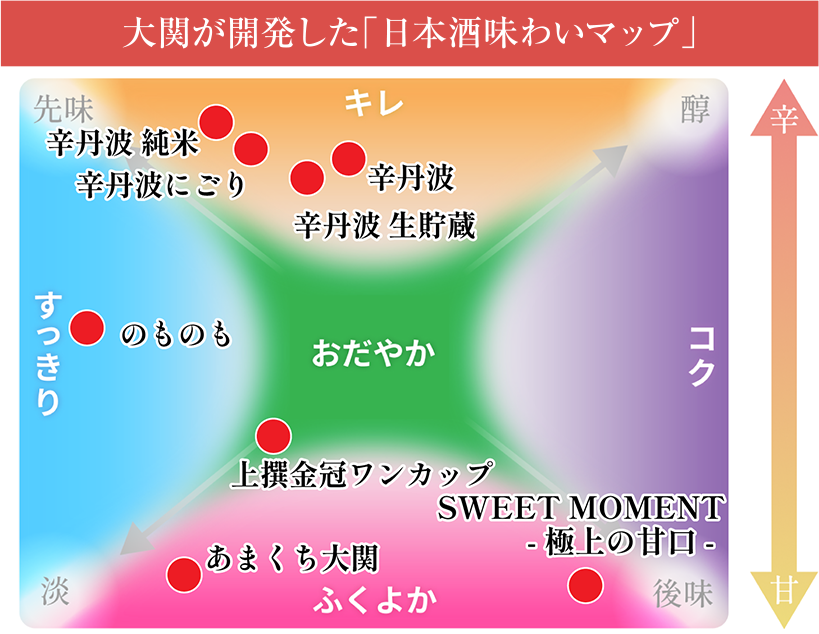
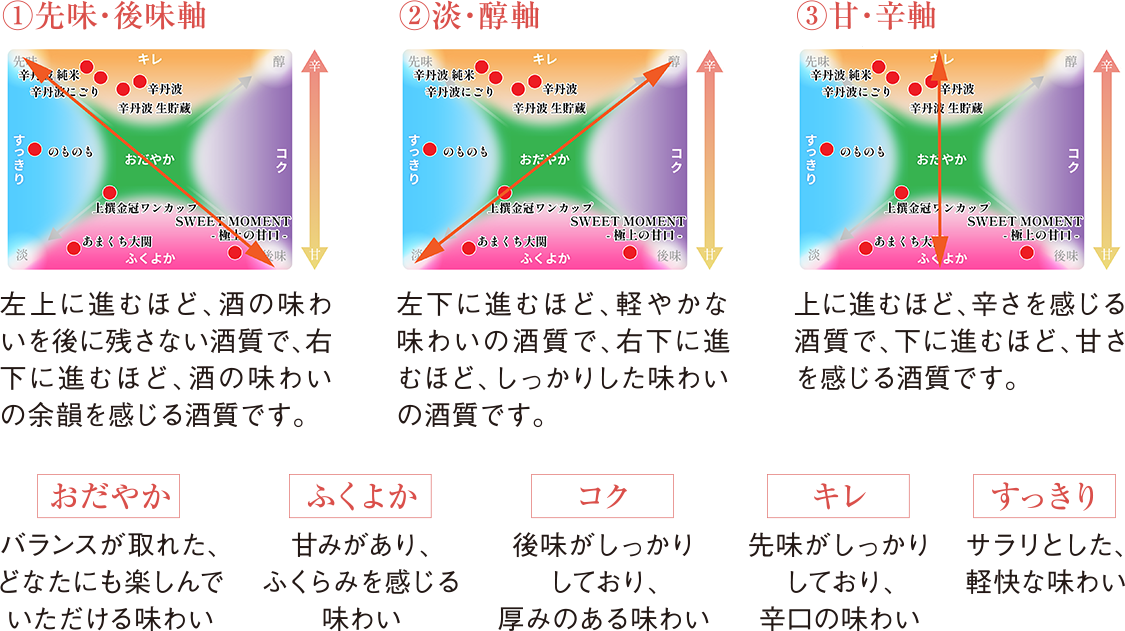
The "Sake Flavor Map" clearly maps sake using numerical values along three axes: "initial taste/aftertaste," "light/full-bodied," and "sweet/dry." It then divides the entire range into five areas: "crisp," "crisp," "rich," "full-bodied," and "mild," expressing the flavor of sake. We believe that these five classifications are more suitable for sensory evaluation than previous taste indicators, and that we have been able to visualize the flavor of sake from a different perspective. Furthermore, the research institute conducted evaluation tests on "pairing with food" based on this map. We evaluated the matching of representative brands from each area with various dishes and seasonings, and identified dishes that pair well with each area.
Like white rice
That sake is "Karatanba".
You can, of course, check the flavor of "Karatanba" on the "Japanese Sake Flavor Map." "Karatanba" is in the "crisp" area, characterized by a firm, dry taste. The map shows that "Karatanba" is refreshing yet retains a rich umami flavor. "Japanese sake brewing is made up of various combinations, which leads to differences in taste. "Karatanba" also has its own unique features, from the rice, yeast, and koji production to the mash preparation. This 'Japanese Sake Flavor Map' has reaffirmed that "Karatanba," the result of these efforts, is a sake that will be loved for a long time," says Deputy General Manager Minetoki. Incidentally, the "Food Pairing Map" showed that "Karatanba" pairs well with a wide range of dishes. "Karatanba" is a sake that goes well with any dish, like white rice. Science has proven that it is a sake that will continue to be enjoyed for generations to come.
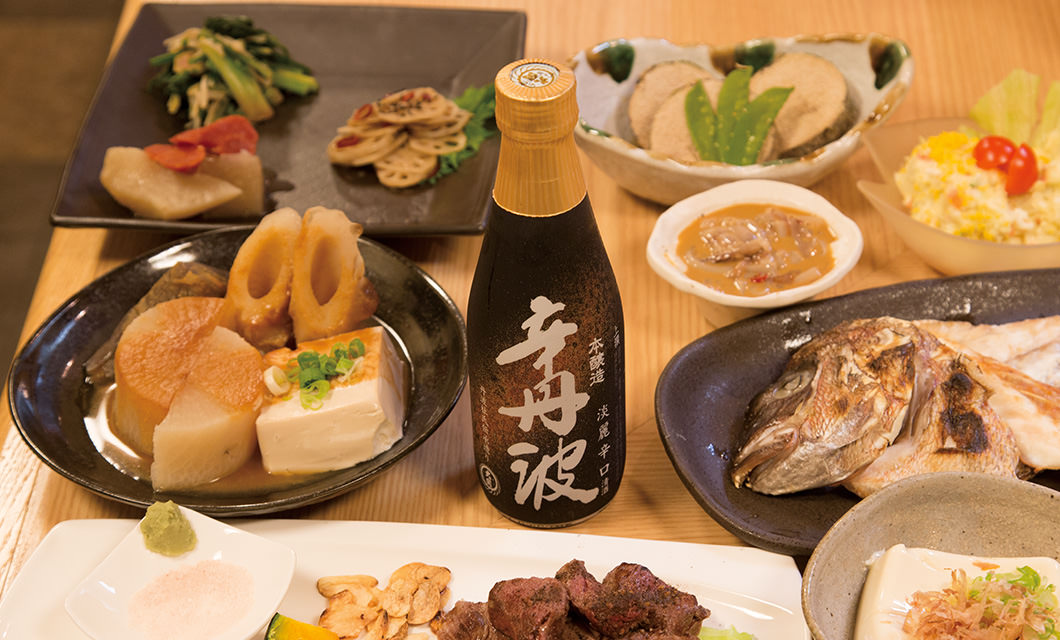
Karatanba is a sake you'll never tire of drinking. Putting aside any scientific proof, the fact that it tastes great when paired with various dishes is the best proof of its quality.

You must be 20 years old to drink alcohol. Enjoy alcohol in moderation.
Drinking and driving is prohibited by law. Drinking alcohol during pregnancy or while breastfeeding may have a negative impact on the development of the fetus or infant.
Copyright(C) OZEKI CORPORATION